
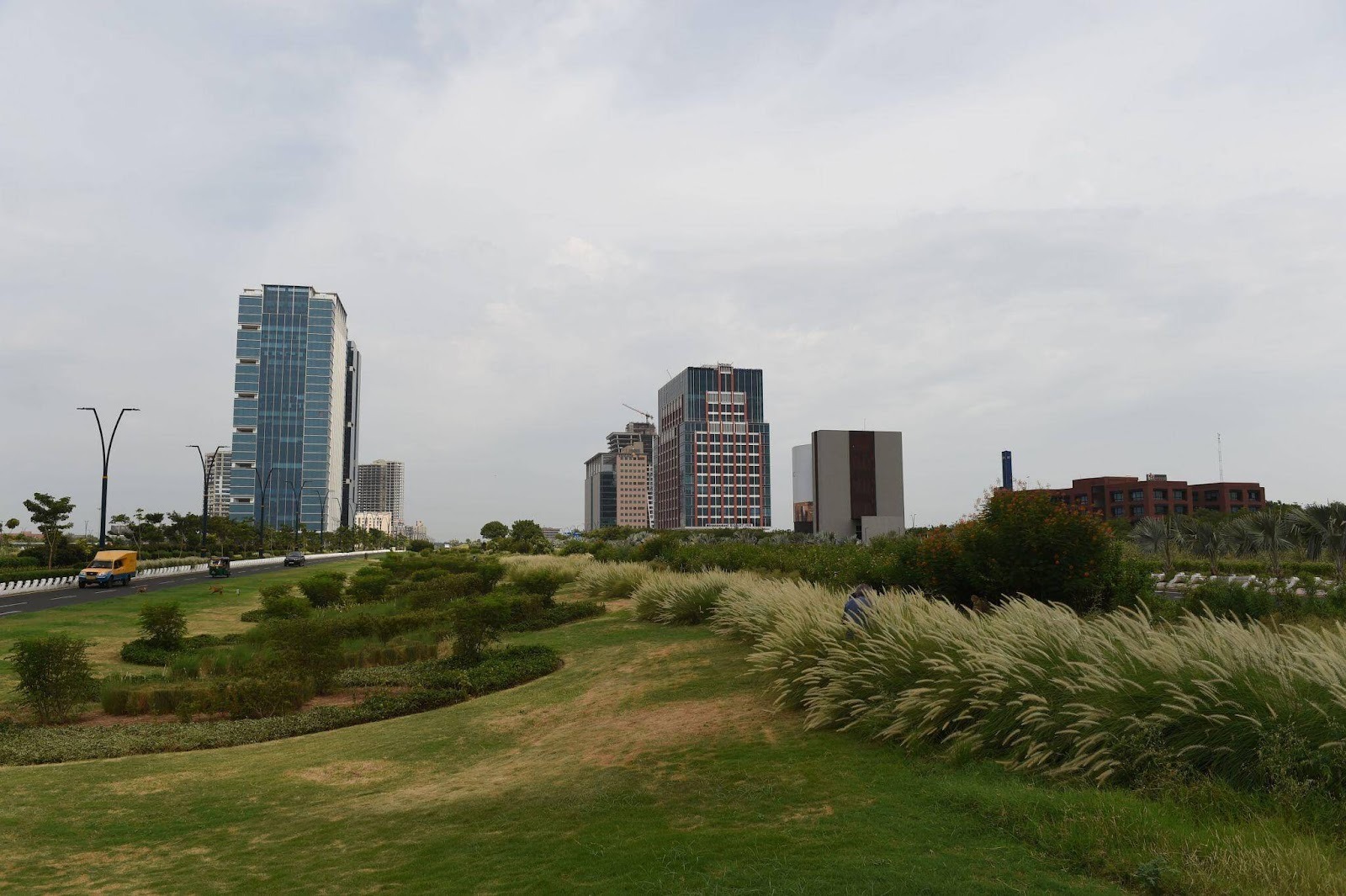
India has no shortage of business districts. Every major city claims to be the next big thing. Yet one name keeps coming up in serious investor conversations. GIFT City.
If you have been watching real estate trends, financial reforms, or global capital movement, you have probably heard about it. And if you have not looked closely yet, this might be the right time.
GIFT City is not just another commercial cluster. It was planned from the ground up with a clear purpose. To become India’s global financial and technology gateway.
Let’s break down why this place is getting so much attention and what it really means for you as an investor.
What Makes GIFT City Different From Other Business Zones?
GIFT City, short for Gujarat International Finance Tec City, is located between Ahmedabad and Gandhinagar in Gujarat. Unlike older commercial districts that grew in pieces over time, this one was designed as a complete financial hub from day one.
That matters.
Most Indian business centers struggle with traffic, inconsistent infrastructure, zoning issues, and long approval cycles. GIFT City was planned to avoid those problems. Roads, utility tunnels, district cooling, power supply, and data connectivity were designed together, not patched up later.
The city operates under a Special Economic Zone model. It also houses India’s first International Financial Services Centre. This creates a regulatory setup that feels closer to global financial hubs than traditional Indian business districts.
If you are an investor, that kind of structure reduces uncertainty. And reduced uncertainty usually attracts capital.
Strong Policy Support and Regulatory Framework
One of the biggest drivers behind GIFT City’s growth is policy backing.
The International Financial Services Centre Authority acts as a unified regulator. Instead of dealing with multiple authorities for banking, insurance, and capital markets, businesses operate under a single system.
That simplifies things. It cuts down delays. It gives clarity.
Tax incentives add another layer of attraction. Units operating in the IFSC get certain benefits on income, capital gains, and transactions. For global firms looking to set up operations in India without facing layered compliance challenges, this setup feels structured and predictable.
And investors pay attention to predictability.
The Rise in Demand for Properties in GIFT City
Real estate demand in GIFT City has grown steadily over the past few years. Commercial towers are seeing occupancy from banks, fintech companies, insurance firms, and global consulting brands.
But it is not just commercial.
Residential demand is picking up too. Professionals working in the IFSC want to live close to work. NRIs are exploring it as a long term asset. Investors are looking at rental income potential.
When people search for Properties in GIFT City, they are not just browsing. Many are comparing it to traditional metro investments in Mumbai, Bengaluru, and Delhi NCR.
Why?
Because entry prices are still relatively reasonable compared to established financial districts. Yet the infrastructure feels planned. The environment feels controlled. And the tenant profile looks stable.
That combination is rare.
Infrastructure That Was Built With Growth in Mind
Infrastructure can make or break an investment destination. In GIFT City’s case, it is one of the biggest selling points.
The city has:
- Underground utility tunnels for electricity, water, and communication lines
- Reliable power supply systems
- Advanced data connectivity
- District cooling systems
- Wide roads and defined zoning
These are not flashy features. They are practical ones.
If you have ever invested in commercial property where tenants complain about power cuts or parking shortages, you know how costly poor planning can be.
Here, planning came first. Expansion came later.
That order changes everything.
The Financial Sector Push
Banks, exchanges, asset management companies, and insurance players are already operational in the IFSC zone.
International exchanges such as India International Exchange operate from here. Global banks have opened branches. Fintech companies are building cross border payment platforms.
When financial activity increases, demand for office space follows. When office space demand rises, residential demand follows. Then retail steps in.
It becomes a cycle.
You are not just investing in a building. You are investing in a growing financial ecosystem.
A Strategic Location Advantage
GIFT City sits close to Ahmedabad airport and major highways. It connects easily to Gandhinagar and Ahmedabad city centers.
For international professionals flying in and out, this accessibility matters. For businesses hosting global clients, it matters even more.
It may not yet have the buzz of Mumbai’s Bandra Kurla Complex. But it has something else. Room to grow without the chaos of overcrowded districts.
And that breathing space often supports long term value growth.
Smart Living and Structured Urban Planning
Let’s talk lifestyle.
Planned green zones, residential towers, commercial spaces, and recreational areas are laid out with intent. Schools, hospitals, and retail spaces are being added in phases.
It is not a city built randomly around demand. It is a city built anticipating demand.
That gives residents a sense of order. Investors appreciate that. End users feel comfortable.
When a city looks organized, buyers feel confident.
The Role of Technology in Property Decisions
Today’s buyers are not just looking at square footage and price. They are asking deeper questions.
Is the property aligned with traditional beliefs?
Does the layout follow Vastu principles?
Can technology help assess that quickly?
This is where digital tools are changing how people evaluate investments.
An ai vastu analysis tool allows buyers to check property layouts against Vastu guidelines without depending entirely on manual consultations. For investors looking at multiple units in a planned city like GIFT City, this can speed up shortlisting.
You can review floor plans. You can compare units. You can evaluate alignment preferences before making a site visit.
For NRI buyers or out of state investors, that saves time and travel.
Real estate decisions are emotional as much as financial. Tools that reduce doubt help close decisions faster.
Rental Yield Potential and Corporate Leasing
Corporate leasing is a major driver here.
Financial firms prefer proximity to regulatory authorities and peer institutions. Being inside the IFSC zone gives them operational convenience.
When firms commit to long term leases, property owners benefit from stable rental streams.
Compared to saturated metro markets where supply sometimes outpaces demand, GIFT City still has room for absorption.
That does not mean returns are guaranteed. No market works that way. But structured growth and policy support reduce speculative volatility.
Investors who enter at the right phase often benefit from appreciation over time.
Growing Interest From NRIs
NRIs have always shown interest in Indian real estate. Yet they often hesitate due to unclear approvals or inconsistent governance.
GIFT City’s structured regulatory environment makes it easier to evaluate risk.
Add to that the appeal of investing in a financial hub positioned for global business, and the interest becomes logical.
For NRIs looking at Properties in GIFT City, the appeal lies in three areas:
- Stable tenant profile
- International style infrastructure
- Regulatory clarity
When those three factors align, confidence increases.
Commercial vs Residential Investment: What Should You Consider?
If you are thinking about entering this market, ask yourself a few questions.
Do you want steady rental income from corporate tenants?
Are you comfortable with higher ticket sizes typical in commercial spaces?
Or do you prefer residential units with broader resale demand?
Commercial investments may offer attractive lease structures but require larger capital. Residential units often provide more flexibility and easier resale.
Your strategy matters.
Long term wealth building?
Short to mid term rental income?
Portfolio diversification?
Clarity on your objective will shape your decision.
Government Vision and Long Term Growth
The project has strong backing from the Gujarat government and central authorities. Development is phased. Infrastructure expansion continues. New towers are being launched in planned cycles.
That phased growth avoids oversupply shocks.
When supply is managed carefully, price corrections remain controlled.
Again, no market is risk free. But structured development reduces random spikes and crashes.
Why Timing Matters
Early entrants often capture the highest appreciation. Late entrants often buy at peak sentiment.
So where does GIFT City stand now?
It is no longer in the concept phase. Offices are operational. Exchanges are live. Residential towers are occupied.
Yet it is not fully saturated.
That middle stage often presents balanced opportunities. Prices reflect progress but may still hold growth potential as occupancy rises.
The real question is not whether GIFT City will grow. Growth is visible. The real question is whether you want exposure during this growth cycle.
Due Diligence Still Comes First
No matter how planned a city is, you still need proper due diligence.
Check developer track record.
Review lease terms carefully.
Understand maintenance structures.
Assess resale potential.
Use digital tools where helpful. An ai vastu analysis tool can help review layout suitability. Financial calculators can project rental returns. Legal advisors can verify compliance.
Structured planning at the city level does not replace smart decision making at the investor level.
The Bigger Picture
India’s push to position itself as a global financial player is not temporary. Regulatory reforms, cross border trading platforms, and global banking participation are signals of a long term strategy.
GIFT City is central to that strategy.
When government vision and private capital align, momentum builds.
And when momentum builds in a planned environment, investors notice.
The buzz around Properties in GIFT City is not based on hype alone. It is backed by infrastructure, regulatory support, and visible occupancy.
Still, smart investors do not follow noise. They analyze fundamentals.
Is demand real?
Are tenants credible?
Is infrastructure reliable?
Is policy stable?
If the answers lean positive, the opportunity becomes clearer.
So, Is GIFT City Worth Your Attention?
If you are looking for a speculative flip, this may not be your game.
If you are looking for a structured financial district with long term positioning, then yes, it deserves serious consideration.
Few places in India combine policy clarity, infrastructure planning, and global financial ambition in one zone.
GIFT City does.
You do not need to rush. But ignoring it completely might mean missing a phase that shapes India’s financial future.
The smart move is simple.
Study it.
Visit it.
Run the numbers.
Use available digital tools for layout checks and valuation estimates.
Talk to leasing agents.
Then decide.
Because informed decisions beat emotional ones every time.
The Road Ahead Looks Structured
GIFT City is not built on flashy promises. It is built on structured planning and policy backing.
As more financial firms set up operations, demand for commercial and residential spaces is expected to expand steadily. With that expansion comes opportunity.
Not overnight riches.
Not dramatic spikes.
Just steady, policy supported growth.
And for many investors, steady beats unpredictable.
If you are exploring India’s next big financial zone, this one deserves a spot on your shortlist.
