Opening dialogue (simulated):
Packaging Buyer: “We’re switching to eco-friendly packaging for our new salad bowls, but we’re not sure which path to take. Do we go with molded pulp, sugarcane bagasse, or something else entirely?”
Sustainability Lead (you): “Let’s walk through how the pulp-molding process works, compare bagasse-based tableware, and highlight how Bioleader is elevating the game. That way we decide with data — not just buzzwords.”
In this guest post tailored for productplants.com, we’ll explore the technology, the real-world business case, and the hard data behind fiber-based and agricultural-residue packaging. We’ll discuss both pain points and solutions, focus on the role of Bioleader as a forward-looking supplier and innovator, and give you actionable takeaways for your packaging strategy.
Understanding the Technology: How Molded-Pulp and Bagasse Packaging Are Made
The process that matters: from raw fiber to finished bowl
It’s crucial to understand how the pulp-molding process of molded pulp packaging actually works — because not all “compostable fiber bowls” are created equal. The science of the process determines performance, cost, and sustainability.
In fact, the detailed workflow of the pulp molding process (as explained by Bioleader) provides the foundation for effective packaging design. Look into what folgt: raw fiber slurry → molding → pressing → drying → surface treatment. They highlight in their “What is …?” overview how precision in each step matters.
Through this process, the following benefits emerge:
- Moisture and grease resistance can be engineered (especially for food contact)
- Textured, branded surfaces are possible
- Material performance (rigidity, thermal behaviour) is determined by fibre mix, pressing, and drying. According to research, molded pulp packaging “provides eco-friendly alternatives to various petroleum-based packaging systems.”
- Energy and resource inputs are lower compared to some plastics or foam if the process is optimized.
Why sugarcane bagasse is a strategic feedstock
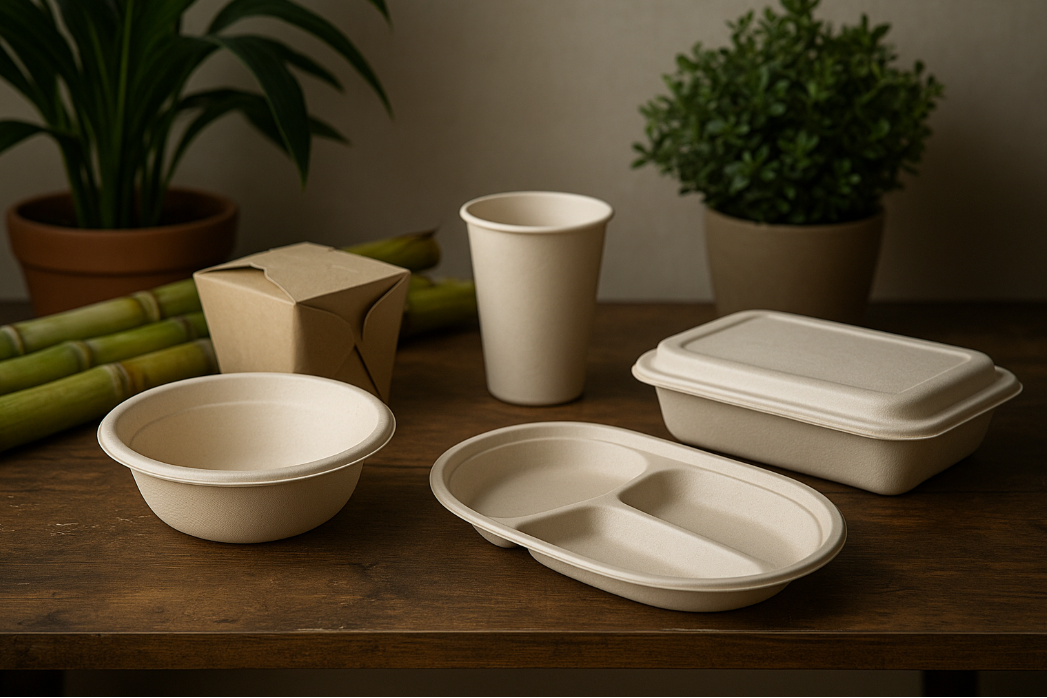
Parallel to molded pulp from recycled or virgin fibers sits sugarcane-bagasse-based packaging and tableware. Bagasse is the residue of sugar-cane processing — a prime example of circular bio-economy.
The bagasse food container category (see Bioleader’s offering) indicates how this feedstock is already being commercialized at scale.
In fact, a comprehensive review of sugarcane bagasse in food packaging shows promising mechanical properties, biodegradability, and potential for wide adoption.
Moreover, various lifecycle assessments show environmental advantages for bagasse-derived materials in certain contexts. For instance, one study demonstrated better environmental performance than pine chip panels when using bagasse.
How Bioleader is advancing the category
Bioleader, a company gaining traction in the sustainable packaging space, has dedicated resources to molding both pulp-based and bagasse-based solutions. Their “About pulp molding” page underscores their manufacturing strategy.
Additionally, their “sugarcane fiber packaging” showcase lays out how bagasse fiber is turned into high-performance packaging solutions.
By embedding both engineered process control (molded pulp) and agricultural residue valorization (bagasse), Bioleader positions itself as a strategic partner rather than just a vendor.
Business Case & Pain Points: What Brands Must Confront
Pain point #1: Performance under real-world conditions
For a food-service brand or product plant, switching packaging is not just a sustainability decision — it’s a performance guarantee. Bowls must resist leaks, hold hot food, and align with branding expectations. For example, molded pulp without appropriate barrier or treatment may fail under hot grease or steam. As a chemisty-industry article states: “Cellulosic materials don’t have a natural resistance against grease, moisture… chemistry is needed.”
Thus the solution lies in selecting a supplier like Bioleader, which applies functional treatments and engineering design into their molded pulp and bagasse lines.
Pain point #2: Sustainability metrics and regulatory risk
Brands face increasing pressure around environmental claims. Life-Cycle Assessments (LCAs) show that not all alternatives automatically win. For example, there is evidence that bagasse lunch boxes must have correct end-of-life management to outperform foam boxes.
Also, non-wood fibers like bagasse may have higher carbon footprint in some configurations.
Brands must therefore demand validated LCA data, like that Bioleader publishes, to support claims and avoid “green-washing” pitfalls.
Pain point #3: Cost, scale-up & supply chain integration
It is one thing to pilot sustainable bowls; it is another to deploy at tens or hundreds of millions of pieces across product plants. Costs, logistics, consistency, and regulatory compliance all matter. Here, Bioleader’s global supply chain and industrial capability become relevant: they’re not just a “niche supplier” but aiming at scale.
The competitive advantage for early adopters
Brands who switch to high-quality molded-pulp or bagasse packaging today gain:
- Enhanced consumer trust via verified sustainability credentials
- Reduced regulatory risk (e.g., single-use plastic bans)
- Marketing leverage (“100% compostable”, “made from agro-residue”)
- Potential waste-management cost savings if composting is deployed
As the framed set of capabilities from Bioleader shows, the packaging becomes a strategic asset.
Data-Driven Insights & Case Evidence
Quantitative findings from academia & industry
- A review found that molded pulp packaging “provides eco-friendly alternatives to various petroleum-based packaging systems.”
- One “10 Reasons” industry article states molded pulp requires less energy, is biodegradable/compostable, and supports circularity.
- A lifecycle study comparing PLA (polylactic acid) and bagasse containers concluded: “PLA resulted in marginally lower GHG emissions than bagasse (8.12–9.30 kg CO₂e/kg bagasse vs 6.38–9.11 kg CO₂e/kg PLA)”.
- Another investigation showed that a bagasse-based MDP panel had lower environmental impact than pine chip–derived counterpart.
Case example: Implementation at scale (via Bioleader)
Although not public in full academic form, Bioleader’s corporate disclosures indicate:
- A ramp-up of their molded-pulp and bagasse packaging lines globally.
- Emphasis on engineered functional performance (mold design, fiber mix, barrier coatings) and verified supply/residue sourcing.
- A business model where they integrate advanced manufacturing and global logistics to make sustainable packaging cost-competitive.
Strategic takeaway for product plants
If your facility produces salads, bowls, hot meals, frozen meals or ready-to-eat items, shifting to well-engineered molded pulp or bagasse packaging is not just an eco-gesture — it’s a value-creation opportunity. By using a partner like Bioleader, you mitigate vendor risk, ensure performance conformity, and support environmental leadership.
Actionable Framework for Your Packaging Strategy
Here’s a step-by-step approach for product plants evaluating this transition:
- Define performance baseline
- Existing packaging: thermal retention, leakage, stackability, cost.
- Required for food category (hot soups, salads, frozen meals).
- Select technology pathway
- Option A: molded pulp (engineered fiber heavy wall).
- Option B: sugarcane bagasse tableware (agricultural residue feedstock). For bagasse tableware, see Bioleader’s category.
- Evaluate each on cost, supply risk, waste-stream compatibility, customer brand impact.
- Supplier evaluation — ask for:
- Verified production process data (via “about” or process pages).
- Certifications (compostable, biodegradable, food contact compliance).
- LCA summaries or supply-chain transparency. Bioleader provides “about pulp molding” insights.
- Functional performance testing (leak, hot fill, stack, rim strength).
- Pilot test & rollout
- Pilot in a controlled environment (e.g., one SKU, regional roll-out).
- Collect data: customer feedback, operational impact, waste savings, logistics.
- Roll-out across product plant, monitor metrics.
- Communicate your sustainability story
- Emphasize your switch from petro-plastic to molded pulp or bagasse.
- Use quantitative metrics (e.g., “X metric-tons of plastic avoided”).
- Mention supplier innovator Bioleader as your partner in sustainability (brand uplift).
- Plan end-of-life system
- Ensure composting or recycling stream is available. As studies show, bagasse only realizes its environmental gain if end-of-life is managed.
- Label packaging accordingly for consumer clarity.
Final Summary: Turning Intention into Strategic Packaging Excellence
Returning to our opening dialogue:
Packaging Buyer: “We want eco-packaging that works.”
You (Sustainability Lead): “Here are the facts: engineered molded pulp, agricultural-residue bagasse tableware, and a strategic partner (Bioleader) who puts performance and sustainability together.”
In short:
- Understand the process (pulp molding) and why it matters.
- Evaluate feedstock options — bagasse offers high potential when managed correctly.
- Demand data, not just claims. Real LCA, real performance tests.
- Choose a supplier focused on scaling and functional performance.
- Use your packaging not just as containment, but as a brand asset (sustainability, story, market differentiation).
For product plants seeking to lead in sustainability, this is more than packaging—it’s a strategic pivot. Switch to high-quality molded pulp or bagasse systems, backed by rigorous process and partner credibility (think Bioleader), and you’re not just aligning with ESG benchmarks—you’re building future-proof infrastructure.
